
Understanding Baptism
Why is baptism important and central to the "good news" of the gospel? A deeper understanding of what Christ did for us leads naturally to an appreciation of His desire that we be baptized.
I want to talk about baptism first by looking at the story of the Ethiopian eunuch in Acts 8. In the biblical account, we see the early Christian preacher named Phillip on the road between Jerusalem and Gaza.
And behold, a man of Ethiopia, a eunuch of great authority under Candace the queen of the Ethiopians, who had charge of all her treasury, and had come to Jerusalem to worship, was returning. And sitting in his chariot, he was reading Isaiah the prophet. (Acts 8:27-28)

Phillip overtook the chariot and asked him, "Do you understand what you are reading?” and he replied, “How can I, unless someone guides me?”
Now passage he was reading in Isaiah was this:
“He was led as a sheep to the slaughter;
And as a lamb before its shearer is silent,
So He opened not His mouth.
In His humiliation His justice was taken away,
And who will declare His generation?
For His life is taken from the earth.” (Acts 8:32-33)
Today, Christians everywhere recognize those verses. They are part of Isaiah's prophecy of Jesus before he goes to the cross. But to the Ethiopian eunuch they were a mystery, so he said to Phillip: "Of whom does the prophet say this, of himself or of some other man?” Then Philip opened his mouth, and beginning at this Scripture, preached Jesus to him.
So using this opportunity and starting at this text, Phillip teaches the Ethiopian eunuch about Jesus. Notice the next verses:
Now as they went down the road, they came to some water. And the eunuch said, “See, here is water. What hinders me from being baptized?” Then Philip said, “If you believe with all your heart, you may.” And he answered and said, “I believe that Jesus Christ is the Son of God.” So he commanded the chariot to stand still. And both Philip and the eunuch went down into the water, and he baptized him. (Acts 8:36-39)
In this particular account, we have the Ethiopian eunuch deciding to accept the word of God, the gospel that came to him. And I want you to notice that after their conversation about Jesus, the eunuch asks about baptism. So when Phillip "preached to him Jesus," part of what the eunuch learned was about baptism.
This is how I want to approach this study. I want to do the same thing. I want us to begin with Jesus. And I think if we understand who Jesus was and what he did, that leads us right into our understanding of baptism.
A Verse That Sums It Up
If you study salvation in the New Testament, you will find verses that talk about people hearing, and believing, and repenting, and confessing. The question is, what? What are they supposed to hear? What are they supposed to believe? What are they repenting of? What are they supposed to confess?
I set a challenge to my daughter, who is a very good Bible student. I said, Can you find me a verse in the New Testament that just sums up everything that Jesus was and everything that He did? It's a challenge because it's everywhere. It's throughout the scripture that it talks all about what Jesus did for us. In answer, she settled on this verse in Titus 2:11-14. I think this is a really good verse that hits a lot of major points about what Christ did for us and the gospel that we preach.
For the grace of God that brings salvation has appeared to all men, teaching us that, denying ungodliness and worldly lusts, we should live soberly, righteously, and godly in the present age, looking for the blessed hope and glorious appearing of our great God and Savior Jesus Christ, who gave Himself for us, that He might redeem us from every lawless deed and purify for Himself His own special people, zealous for good works.

If you really want to understand Jesus, that's what the whole gospel is about. The whole of the Bible is teaching who He was. Let's stop and look closely at some of the details in this verse: "The grace of God that brings salvation has appeared to all men." Jesus was that grace. He was that salvation, and He has appeared to everyone through the gospels that record his life, and the salvation that he brought is there for all mankind.
And He taught us "that we should deny ungodliness and worldly lusts, and we should live soberly, righteously, and godly in this present age." We have to live a good life to be pleasing to Christ and to have that salvation.
Notice also that then it says,"Looking for the blessed hope and glorious appearing of our great God and Savior Jesus Christ." He's going to come back. He died and He was resurrected, and then He spent time with the disciples and He was taken up into the clouds, and He's coming back the same way. Christians are all looking for the hope of that appearing.
And the verse calls Jesus "the great God and Savior." This is something you have to believe. You have to hear this story and know who Jesus was, and you have to believe that He was the Son of God--that He really is deity and that we should be serving Him.
Then lastly, it says, He "gave Himself for us." And that's really the center of the story of the gospel, that Jesus came to this earth, and He suffered and He died on the cross, a horrible agonizing death... for us. He gave Himself up. He suffered all that terrible agony because of the sins that we had committed and because he wanted to save us. That is the story of the gospel.
In Acts 4:12, the scripture says, "Nor is there salvation in any other, for there is no other name under heaven given among men by which we must be saved." The only one who's going to save us from our sin is Jesus. There's no other way. When He was here, He said, "I am the way, the truth, and the life. No one comes to the Father except through Me." (John 14:6) He is the one who's going to show us how to get there.
Because He Commands It
Next, I want to talk about what Jesus told his apostles at the end of His life. He came, He lived His life, and He was crucified, and then He was raised from the dead, and we need to listen to what He tells us to do. He spent time teaching with His disciples, the ones that would become the Apostles, the Twelve, and at the end of Matthew's account we're going to look at what He said to them just before He went back to heaven.
And Jesus came and spoke to them, saying, “All authority has been given to Me in heaven and on earth. Go therefore and make disciples of all the nations, baptizing them in the name of the Father and of the Son and of the Holy Spirit, teaching them to observe all things that I have commanded you, and lo, I am with you always, even to the end of the age.” Amen. (Matthew 28:18-20)
This is how the gospel of Matthew ends. I want you to think about this. Jesus was crucified. He was put in the grave. He went and ascended into heaven. He was there at the right hand of God. And He comes back with all authority. All authority was given Him by God. And when He comes back, what does He say? With that authority, the right to command all of us, the right to tell His creation to do whatever it should do. And He tells these Twelve, the Apostles, Go make disciples and baptize them and teach them all the things that I've commanded. This is central to the scripture. If we're going to be saved by Jesus, we need to listen to Him. And He says, If you're going to be my disciple, you need to be baptized. This is the command He gave just before he returned to heaven.
All The Conversions In Acts
When disciples were made in the scripture, most of that is recorded in the book of Acts. In the book of Acts, you can see all these people who the gospel was preached to, and then they were converted. The question is, how were they converted? You can just go through that list of scriptures and read about those people. Those accounts are summarized in the chart below.
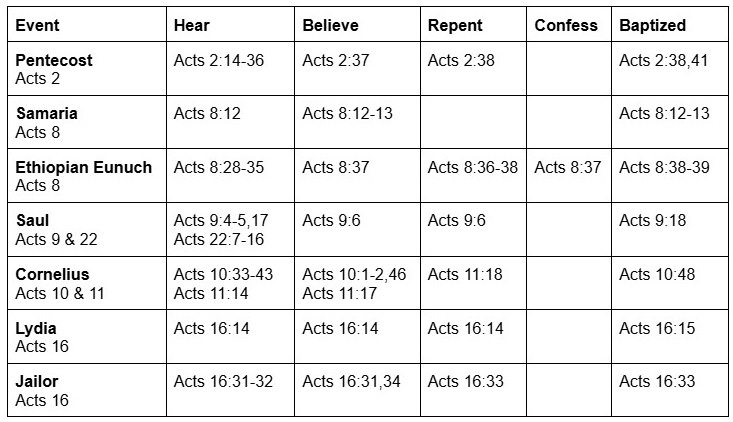
We have the people on the day of Pentecost (Acts 2:14-38), people in Samaria (Acts 8:12-13), the Ethiopian eunuch (Acts 8:28-39), Saul (Acts 9:4-18, Acts 22:6-16), Cornelius (Acts 10:1-48, Acts 11:1-18), Lydia (Acts 16:14-15), the Philippian jailer (Acts 16:31-34), all of them. If you look and you see what they did--they heard, they believed, they repented, some of their confessions are recorded, and they were baptized. Look at every single one of these accounts. If you go to the scripture you say how were people converted in the first century, when they heard the gospel, and the answer is they were baptized. They followed the command that Jesus gave. They did what the apostles told them to do, what Jesus commanded. They were baptized.
A Spiritual Thing
Now, I think that one of the things we have to do when we study baptism though, just like a lot of things in the scripture, is we've got to look past the physical to the spiritual. I was thinking about the incident in the Old Testament about Elisha in 2 Kings 6:16-17, when there's an army coming against him and he's there with his servant, and his servant is scared and he's like, Look, we're doomed. And Elisha prays to God and says, Can you open his eyes so he can see what's really there? And he sees that behind him on this mountain are all the hosts, the angels, ready to fight that army, right? Because now he can see the spiritual thing. This is also true of baptism. There's a spiritual thing going on when you're baptized. It's not about going down into water and getting wet. It's a spiritual moment.
I think the best scripture to help us understand the spiritual side of baptism is Romans 6:3-7.
Or do you not know that as many of us as were baptized into Christ Jesus were baptized into His death? Therefore we were buried with Him through baptism into death, that just as Christ was raised from the dead by the glory of the Father, even so we also should walk in newness of life.
For if we have been united together in the likeness of His death, certainly we also shall be in the likeness of His resurrection, knowing this, that our old man was crucified with Him, that the body of sin might be done away with, that we should no longer be slaves of sin. For he who has died has been freed from sin.
I'm going to highlight a few things here that I want you to notice--the spiritual things that are happening when a person is baptized. First, it says that "as many of us as were baptized into Christ Jesus were baptized into his death." The baptism that is happening is connected to Jesus's death, and we see in the next section, His burial and His resurrection. I want us to get this. Whenever we are baptized, it is a death. It is a connection to Jesus's death. When we are coming out of that water, when we're raised out of it, we're raised to walk in newness of life. We're given a new life through baptism. This is in the likeness of His resurrection. He suffered and died, and was put in that grave, and then He arose. And in the same way, we experience the same thing in baptism. We're connected to that death and that burial.
Then, we're supposed to walk in newness of life. Notice what was crucified. That old man was crucified, so that we can have this new life. These are the spiritual things that are happening when we are baptized. We're connected to his death and his burial and his resurrection. It's a metaphor for that. It's an analogy. It's a spiritual thing that's happening. It's not just about going into water.
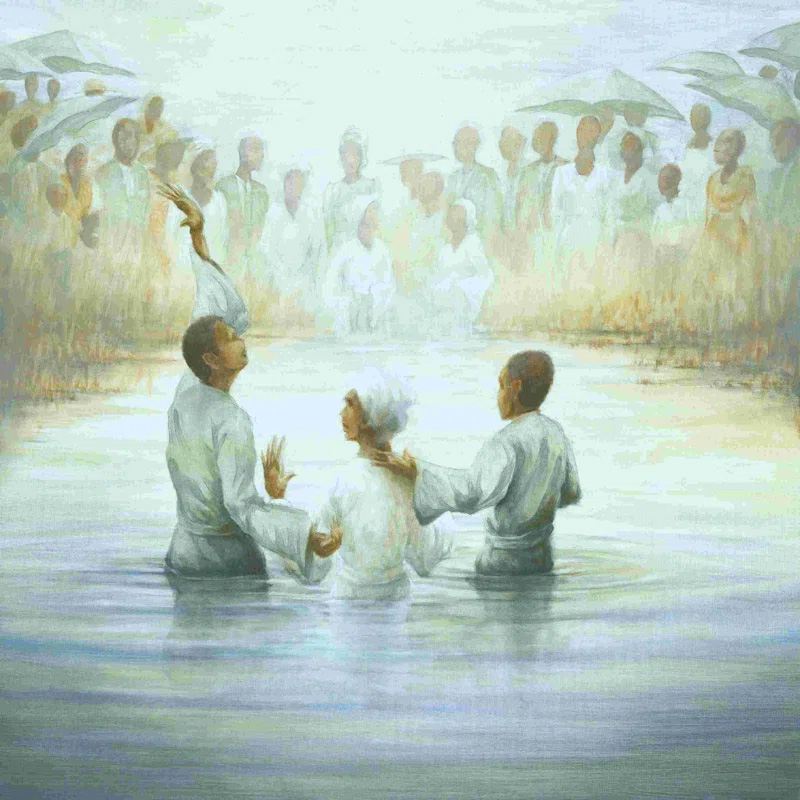
When we come up out of that water, this is what lets us walk in a new spiritual life. We're a new creature. We're connected directly to His resurrection. There's a resurrection there to walk in newness of life. But there's also the resurrection that Jesus brings when He comes again, as we already mentioned earlier. He's going to come again, and He's going to raise us to eternal life. We have that hope. That's connected here too.
When we go into that water to be buried, when we're crucified here, our old man is nailed to the cross. What goes into that water is not the same person who comes out of it, because that old man is nailed to the cross. These are the spiritual things that are happening when we're baptized.
Get Rid Of Sin
Let's turn now to Acts the second chapter. In Acts, at the beginning of the church, we really have the first sermon preached. When the gospel begins to spread after Jesus has gone up into heaven, Peter gives a sermon. At the end of that sermon, when he has convicted them all of sin and especially specifically of having crucified Christ. In Acts 2:38-39, it reads:
Then Peter said unto them, Repent, and be baptized every one of you in the name of Jesus Christ for the remission of sins, and ye shall receive the gift of the Holy Ghost. For the promise is unto you, and to your children, and to all that are afar off, even as many as the Lord our God shall call.
This verse tells us another spiritual thing that's happening right there in baptism. He says that we are to be baptized for the remission of sins. Now that word remission, I don't think we use it very much really in the English language today. Sometimes you'll hear it come up with cancer. But if you go look at it in the Greek, the word remission means to be pardoned, to be released from imprisonment. Think about how that connects back to Romans, which said we were slaves to sin. But Christ released us from that. He is washing away our sins. He is pardoning us of our sins. That's the purpose of baptism, to wash away those sins so that we can live anew.
Christ Lives In Me
Galatians 2:20 is another verse that sums up so much about the gospel. When we are baptized and we get rid of sin, this is how Paul describes what has happened to us. I think this is one of the most beautiful verses in scripture. I have it on my wall so that I see it every morning. It says:
I have been crucified with Christ. It is no longer I who live, but Christ lives in me, and the life which I now live in the flesh I live by faith in the Son of God, who loved me and gave Himself for me.
See, all that started by being crucified with Christ--and that happens in baptism. And when I came out of that water, when you came out of that water, when anyone who is converted comes out of that water, it is to no longer live for themselves, but that Christ should live in them. And to remember that Jesus loved me and gave Himself for me. This is what baptism is all about.
Look at Galatians 5:24:
And those who are Christ’s have crucified the flesh with its passions and desires.
That's back to that old man again. When we're baptized, the old man is put on that cross. As Christian, we're often talking about baptism to people who need to be converted and are first hearing the gospel, and that's important. But let's make sure that those of us who have been baptized, remember that this is what we did, and we don't go back to dig in the grave. That old man has been crucified and done away with and buried. We're not supposed to be living for our fleshly passions and desires anymore.
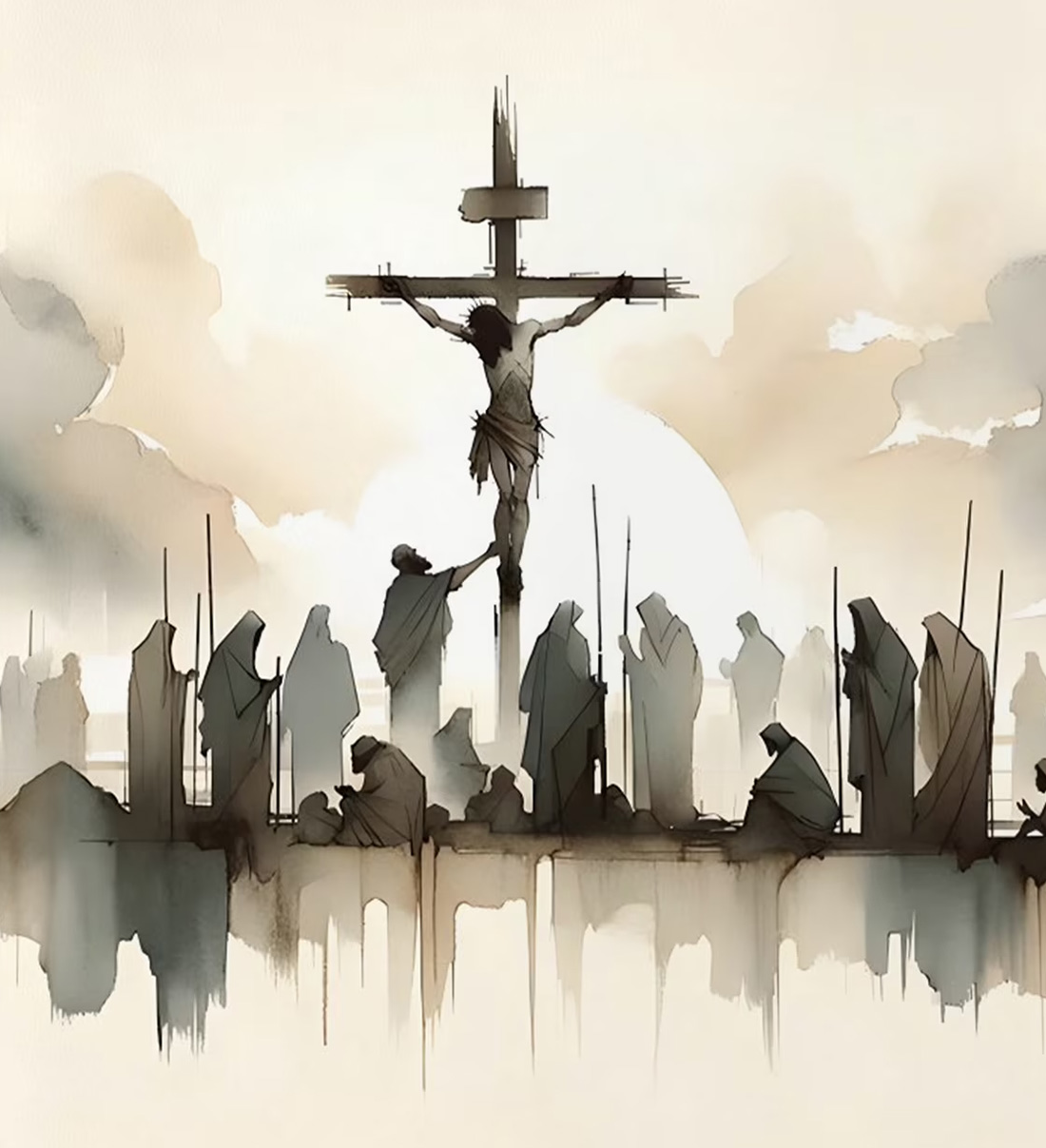
In Galatians 6:14, it says something else similar. The Apostle Paul brings this up again:
But God forbid that I should boast except in the cross of our Lord Jesus Christ, by whom the world has been crucified to me, and I to the world.
We're no longer living a fleshly life. That world was crucified to us. We're crucified to it. That is not our life anymore. We are living in this new life for Christ. And all of that occurred, that turning point in our life happened, when we were baptized.
Put On Christ
Let's look at one more verse in Galatians that brings up baptism. Galatians 3:26-27 says:
For you are all sons of God through faith in Christ Jesus. For as many of you as were baptized into Christ have put on Christ.
"Have put on Christ" is the phrase it uses. If you look up that phrase in the Greek, it means to put on Christ like a garment, like clothing. You're putting Him on. Putting on Christ. What does that mean? There's another place where it uses a phrase like this in Romans 13:12-14:
...Let us cast off the works of darkness, and let us put on the armor of light. Let us walk properly, as in the day, not in revelry and drunkenness, not in lewdness and lust, not in strife and envy. But put on the Lord Jesus Christ, and make no provision for the flesh, to fulfill its lusts.
This gives us a little more detail what it means "to put on Christ." It means to live properly, not in revelry, drunkenness, lewdness, and strife. That's not what Christ is. That's not what Christ does. We're supposed to put on His life, not our life, and definitely not a corrupt, sinful life. We have to be changed by baptism.
In Ephesians, there's a section of scripture that talks about what it means to be part of the church, why Jesus created the church. In Ephesians 4:11-12 it says He gave some to be apostles, some preachers, some teachers. He talks about all these things and the work of the church there. And when he gets to the end of that section of scripture, and it reads:
Till we all come in the unity of the faith, and of the knowledge of the Son of God, unto a perfect man, unto the measure of the stature of the fulness of Christ: That we henceforth be no more children, tossed to and fro, and carried about with every wind of doctrine, by the sleight of men, and cunning craftiness, whereby they lie in wait to deceive; But speaking the truth in love, may grow up into him in all things, which is the head, even Christ:

This is what it means to put on Christ. This is what we are working towards all the time as a church, the things that we do together, we're all working to be more like Christ, to be more like this perfect man, the fullness of Christ, the head of the church. That is our goal. That's what it means to put on Christ, and that process starts when we're baptized.
I wanted to connect this to a parable that Jesus said in Matthew 22:
The kingdom of heaven is like unto a certain king, which made a marriage for his son, and sent forth his servants to call them that were bidden to the wedding: and they would not come.
They were invited, but they had excuses, and they didn't come. And in fact, some of them, they seized his servants and treated them spitefully. When the king heard about that, he destroyed those people, and he said to his servants:
The wedding is ready, but they which were bidden were not worthy. Go ye therefore into the highways, and as many as ye shall find, bid to the marriage. So those servants went out into the highways, and gathered together all as many as they found, both bad and good: and the wedding was furnished with guests.
This is an image of God's household and a feast with Him, to sit down at God's table to celebrate this wedding. And the ones who were first asked to come refused, but others came. But then look at this last part:
And when the king came in to see the guests, he saw there a man which had not on a wedding garment: And he saith unto him, Friend, how camest thou in hither not having a wedding garment? And he was speechless. Then said the king to the servants, Bind him hand and foot, and take him away, and cast him into outer darkness, there shall be weeping and gnashing of teeth. For many are called, but few are chosen.
We have to put on Christ. We have to wear this garment of righteousness and become like Jesus. Or else we're going to be like this guy, called to the wedding feast, sitting there when the King arrives, and the King is going to say, Where's your garment? You shouldn't be here. I don't think any of us want to be in that situation. We really have to be transformed by baptism and putting on Christ.
What If You Refuse Baptism
We have to remember that when people refuse the King, and they don't hear the call, what we're giving up by doing that. If we don't accept the salvation that Christ brings and obey the command that He gave us to be baptized, what's the consequences of that? What have we done by doing that? If you're not baptized, I want you to look at this list. This is just the things from the scriptures that we've been reading, what it said happened when you were baptized. And if you turn that around, that means this is what happens when you're not.
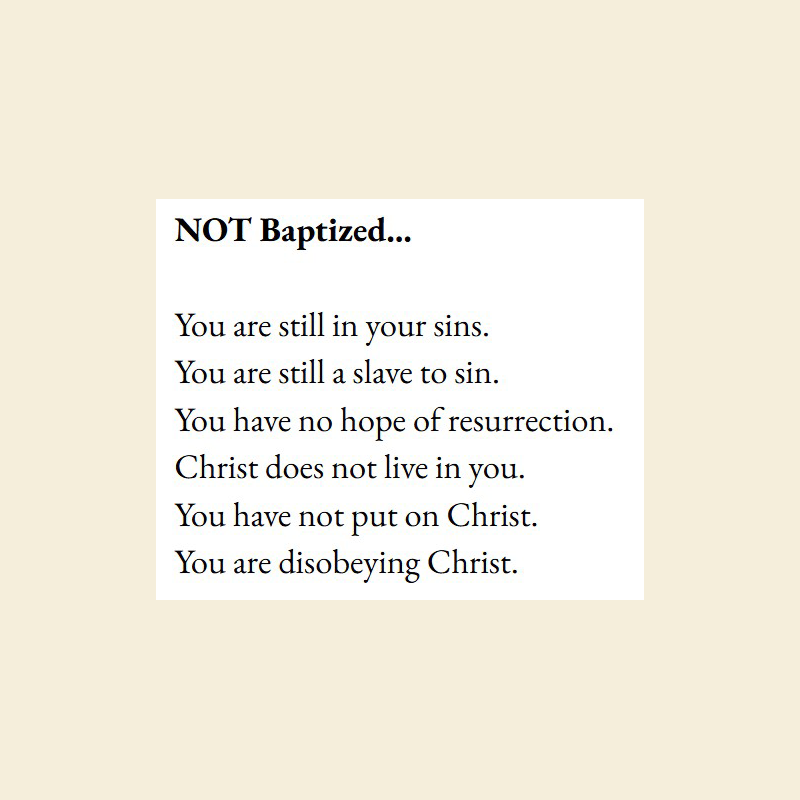
If you're not baptized, you're still in your sins. Your sins are there, still staining you. You haven't been washed white as snow.
In fact, you're still a slave to sin. That's what it said in Romans. You are enslaved and imprisoned by your sin. Christ is ready to free you from that. But you are still in the prison and won't come out if you haven't been baptized.
In the scriptures, baptism is directly connected to resurrection. You have no hope of resurrection if you are not baptized.
Christ does not live in you if you are not baptized. You have not become a new creature. How are you going to be a new creature if you don't let Christ wash away your sins and you don't crucify that old man?
We put on Christ when we are baptized. If you don't get baptized, you haven't done this. When people look at you, they're not seeing Christ.
If you haven't obeyed His command to be baptized, the bottom line is you're disobeying Him. When He came back from heaven and He said, I have all authority to the Twelve, here's what I want you to do. He said, Go out, make disciples, baptize them, and teach them all the things that I've commanded.

What Hinders You
Hearing this story, this gospel, we should rejoice when we receive it, but sometimes people are resistant.Something holds them back. If this is your situation, I want you to think about what hinders you from being baptized. That was the question the Ethiopian eunuch asked, but he asked it in a positive way. He said, there's nothing hindering me from being baptized. He heard the gospel and he was ready and he said, look, there's water. He wanted to do it. What's hindering you? Is there something hindering you?
I want to go back to an Old Testament story here. The story of Naaman. It's recorded in 2 Kings 5. I think there's so much in this story about being resistant to God's salvation.
Naaman, commander of the army of the king of Syria, was a great man with his master and in high favor, because by him the Lord had given victory to Syria. He was a mighty man of valor, but he was a leper. ESV
Namaan was a powerful man, but he had leprosy. If you keep reading this story you find out he had a slave girl that was captured from Israel. And she said, back in Israel, there's a prophet who could heal that leprosy. And so Naaman, he asked the king, can I go? The king says yes. He gives him all these gifts to go give to that prophet. He travels all this distance to go find the prophet. He even talks to the king in Israel. The king there is scared and tears his clothes. He's like, this guy expects me to heal leprosy. They're just conspiring for an excuse against me. Nobody can do that, right?
But when Elisha the man of God heard that the king of Israel had torn his clothes, he sent to the king, saying, “Why have you torn your clothes? Let him come now to me, that he may know that there is a prophet in Israel.” So Naaman came with his horses and chariots and stood at the door of Elisha's house. And Elisha sent a messenger to him, saying, “Go and wash in the Jordan seven times, and your flesh shall be restored, and you shall be clean.” ESV
Elisha the prophet of God told Namaan what to do. He told him how to get rid of his leprosy. But look at Namaan's reaction:
But Naaman was angry and went away, saying, “Behold, I thought that he would surely come out to me and stand and call upon the name of the Lord his God, and wave his hand over the place and cure the leper. Are not Abana and Pharpar, the rivers of Damascus, better than all the waters of Israel? Could I not wash in them and be clean?” So he turned and went away in a rage. ESV
He came all that way. He brought all these gifts. He wants this miracle to happen to save him from his leprosy. And when he gets to the moment, he is not satisfied with the answer, with the way the prophet tells him to go be washed and cleaned. Notice the things that hindered Nathan: His pride. I think he wanted it to be a big thing to happen. He wanted to see this spectacle. He wanted the prophet to come out, like he said, and wave his hand over the place and do something spectacular. And it wasn't enough that he just sent his servant out there and told him what to do. "Why didn't he come out himself?" I'm sure Naaman was thinking. There's some pride there hindering him.
I was thinking when I read this, you know, Naaman was a mighty man of valor, a great man over an army. And I'm sure he was ready to do whatever that prophet asked, some great deed. It reminded me of the stories of the ancient Greeks, like Hercules or Odysseus where these mighty men would go out and do some great act of valor and quest to achieve something. And if the prophet had come out and asked him to do something like that, I'm sure he would have done it, he would have done some great thing.
But the prophet just told him to go wash in the river. And in fact, the river he doesn't think is worth anything. And he just rejects it. But if they'd asked him to do something great, he would have done it. Now, look at the end of the story:
And his servants came near, and spake unto him, and said, My father, if the prophet had bid thee do some great thing, wouldest thou not have done it? how much rather then, when he saith to thee, Wash, and be clean? Then went he down, and dipped himself seven times in Jordan, according to the saying of the man of God: and his flesh came again like unto the flesh of a little child, and he was clean.

When he finally just did it, when a servant just said to him, look, just wash and be clean, then he accepted the word of the prophet, and he did it. Are we like this? Do we have some pride that Jesus didn't come to us Himself? And he just sent his servants, somebody to come tell us the gospel? Is that what our hangup might be? Is there pride there?
Or are we stuck on the water? It's just water. I shower or bathe every day. Is it not great enough what he asked us to do? Just being washed in water?
But think about that--it's not us that he asked to do the great thing. Jesus did the great thing. Jesus came. He lived a life that we could see as this beautiful model of how to live. He suffered for it. He was beaten and mocked and crucified, all for us. He did the great thing. We should just accept the salvation. We should just go wash and be clean.
This is similar to the story of Saul, the persecutor of the early church, who became the Apostle Paul. Saul who also kicked against the goads, who didn't want to listen to Jesus. But finally he did when he saw Him on the road to Damascus. And then Ananias comes to him later, when Saul can finally hear it, he says:
"And now why are you waiting? Arise and be baptized, and wash away your sins, calling on the name of the Lord."
This is what is offered to every man and woman on the face of the planet. You can quit waiting. You can be baptized. You can have your sins washed away and call on the name of the Lord. And you can come out of that water, a new creature, ready to live in newness of life. And you can get to work putting on Christ, striving to live how He wants you to live. Then when people look, they will see Christ and not you. You can live a life for Him because He loved you and sacrificed Himself for you.
 More Bible Study Articles