
Why Dune: Imperium Is So Good!
Marooned on a desert island, one trunk survives the shipwreck or plane crash. Inside are only the best of the best of your board games. The ones you will gladly play every day while waiting to be rescued, or maybe you won't care to be rescued because you have that trunk of games so what else do you need? So what games are in that trunk?
There are a few games that are so good, so tightly designed, so engaging that they are a pleasure every time they hit the table. And those really good games hit the table a lot in our house. Dune: Imperium is one of those games. It may be THE game. But why? What makes it so good?
Difficult Choices
The core gameplay in Dune: Imperium revolves around making the right choices at the right time. Each turn, you play one of your Agents to activate a space on the map and reap its reward. But there are so many things you need to do--harvest spice, gather water, and earn money. But which to focus on now? You only have two Agents but you need to forge alliances with the Emperor, the Spacing Guild, the Bene Gesserit, and the Fremen. But which is the priority? And what about combat? You need to build your garrison for future conflict, but troops are needed in battle now. Do you risk them? And don't forget, you must, you MUST train your swordmaster so you get your third Agent into play.
Only one Agent can occupy each spot, and your opponents are all eyeing the same spaces, the same rewards. As much as you desire certain benefits from the board because they will bring you stepwise to the fruition of your grand plan for victory, your opponents have their own plans that inevitably intersect, overlap, interrupt, and block yours. You didn't think they would sit idly by, did you?
The mechanic where each coveted space on the board can only be occupied by one player at a time is part and parcel of worker placement games, but in Dune: Imperium the pressure for the board spaces is extreme. You pay attention to each player's move, not only because it reveals their plans and motives, but also because you are on the edge of your seat hoping that they don't block your next play. But they will. Oh, they certainly will--if not this turn, then the next or the next, perhaps at the most crucial inopportune time, perhaps because that was part of their plan all along. And then what will you do?

You see, in Dune: Imperium, you must be flexible. When the board changes you must adjust. You must understand that what you want and what you need are not always precisely the same, and that there are other paths, other good plays, maybe not optimal, but right now, with this hand of cards, with what your opponent just did, these are the options, and you must seize the opportunities that appear.
Intense Strategic Combat
Combat systems in board games are fraught with peril for the designer. It's easy to over-design them, let the coolness of miniatures and map hexes and terrain take over the game, which often leads to the game bogging down and only being enjoyed by a certain segment of players.
Dune: Imperium does not do this. Its minimalist combat system fits the game. It is part of the game, not the whole game. Combat is a tool in your arsenal, a means to an end, it is not the end or the goal.
But the simplicity of the combat system is deceptive. Each player has a garrison of troops. Each round, there is a battle that offers certain rewards. If these rewards look good to you, use some Agent actions to push troops into combat. Have the most strength, the reward is yours, or a lesser reward if you are second or third place. But be mindful, all troops committed to battle are eliminated, even the victors.
The beauty of this system is that again it is providing crucial choices. Do you commit troops to this battle, or save them for the future? How few can you send and still win? What is your enemy going to commit? Can you afford to let your enemy win the reward? Can you even spend your precious Agent actions getting involved in this battle, or do you need to let it go so you can pursue other priorities?
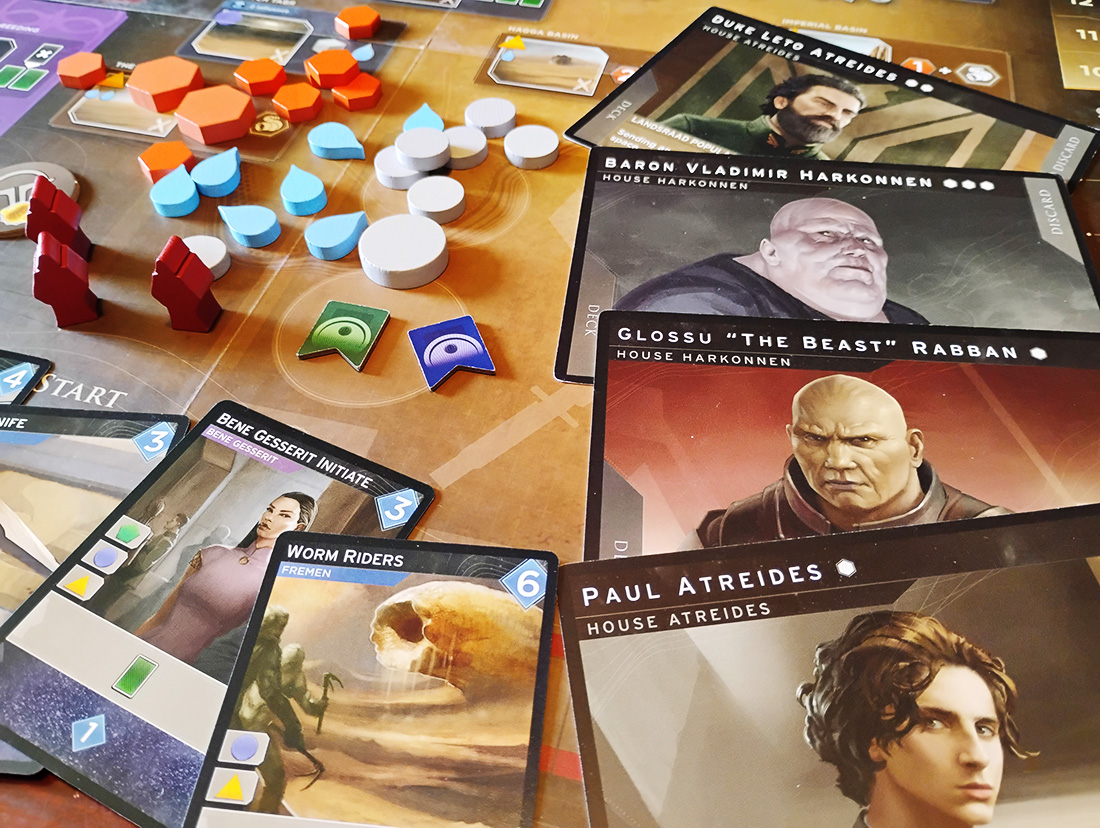
Add to these considerations the effects of Reveal turns and Intrigue cards on battle. After their Agent actions are done, players get a Reveal turn to show the cards they did not use yet. These often shift the battle strength a little either way, maybe just enough to eek out a victory. But even more importantly, when the battle is resolved at the end of the turn, players may use their hidden Intrigue cards to affect combat. You may think you've committed enough troops, but that may not be the case. You have to consider what cards you hold, and how many (if any at all) the enemy has. But not all Intrigue cards are combat cards, so maybe yours are useless and theirs are just a bluff.
The bottom line is, as a strategic commander, you cannot be sure you will win. You have to plan, to prepare, to commit at the right moment and for the right reward, but know it all may come crumbling down around your ears. This juicy uncertainty makes the conflicts intense and emotional. One turn you may exult in a hard won victory and appear to be a military mastermind, yet on another weep and curse the resources it took to field all those troops that utterly failed to achieve your goals.
Deck Building With A Board
There was a time when deckbuilding games were the latest innovation in card game design. And then somewhere along in the development of this mechanic, certain designers married deck building to a board (Clank! is a game that did this particularly well). Dune: Imperium continues the evolution of this mechanic.
The actual effect of any Agent you play is determined by a combination of the space you choose and the card you play, creating an experience that is much like playing a good combo in a collectible card game. Additionally, each card has two uses--creating another layer of choices. If you use it to play an Agent, it will do one thing, but if you save it for your Reveal turn it will give you a different effect. How you manage and use your cards to achieve your particular goals and plans is where your skill as a player comes out.

Two other aspects of Dune: Imperium's excellent game design are evident on the cards as well--the iconography and thematic elements. Like the combat system, the visual design of the game is minimalist. From the simple colors and shapes of the tokens, to the clear icons representing what each card does, the game presents itself clearly and without a whole lot of clutter. There is very little text in the game. The text is in the titles and in the rulebook where it belongs, and the icons express everything you need while playing.
Conclusion
Over the years, many games have tried to recreate the experience of a popular book or movie. Most, unfortunately, fail. When the intellectual property represented is deeply loved, those failures seem almost like betrayals. But sometimes, game designers will faithfully flesh out the theme of the original and at the same time provide a truly solid game. Dune: Imperium is of that rare category. It feels like Dune, with the intrigue, machinations, and sudden violence set among Frank Herbert's astoundingly realistic fictional future. And, it is quite simply a great game.
If you haven't yet experienced the epic struggle of imposing your will upon the galaxy in a game of Dune: Imperium, it is time to take the plunge. You won't regret picking up this game. Likely, you will form a spice addiction and play it often. And if intensity gets too much, remember, fear is the mind-killer, the little-death that brings total obliteration. Face your fear. Permit it to pass over you, and when it has gone past, only victory will remain.
Post-Script
There are actually two Dune games and several expansions, so some advice in that area might be warranted. First, we have both games and all the expansions. They are all good. We do prefer the purity of the original game over Dune: Imperium - Uprising. There are many excellent enhancements in that game (Contracts, the reduced Swordmaster cost for second comers, and alternate play on the High Council come to mind), but Spies and Worms are an additional layer of complexity that not everyone warms to. Worms in particular create significant swings in Victory Points that you may not be prepared for if you are not a Dune veteran. As far as expansions, we use Immortality and Bloodlines less often and favor Rise of Ix. Dreadnaughts, Tech Tiles, and Interstellar Shipping are all easy to wrap your head around and integrate flawlessly with the original game. However, we often mash it all together because there's great stuff in all the expansions.
 More Game Articles